Q209 Call: OnMobile Says Deployments Have Slowed; Telisma Vs Nuance; AdRBT

The Content Costs
When asked about the increase in content costs, which we’d pointed out in our analysis of their Q2 earnings, OnMobile Global CEO Arvind Rao said that this is a “fixed monthly fee that we’re paying is to a third party which is giving us some services which are used for launching a new project or a new product that a very large, but will not be rolled out until next quarter. That is a line item, which has no link to our existing revenues. It’s fixed on a monthly basis, based on certain parameters and results that they have to deliver to us.” Our sense (this is not officially confirmed) is that these are payments being made to the content partners that OnMobile has signed up in South India, and it corresponds with two significant deals they’ve struck - for powering the Ringback Tone (RBT) platform for Airtel in South India, and for du in the UAE.

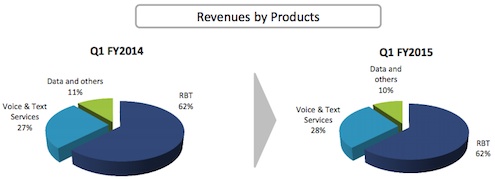
Revenue Split
15-20% from data products
35-40% from voice portals etc
35-40% from RBT etc

AdRBT
Very little on the AdRBT: OnMobile expects to complete the test launch of AdRBT with Vodafone by the end of November and declined to share details of the results in the interim. They’re going slow on AdRBT in order to iron out the bugs, based on usage trends from the pilot. Results are encouraging, says Rao - “the numbers, based on consumer recall, are better than for the Internet.” Mobile Marketing SBU has around 20 odd people, who are working on two very large projects.

Impact of the slowdown?

(more…)


Q2-09: OnMobile Content & Royalty Costs Up 55% To Rs. 11.67 Crores

Q2 Onmobile Global SnapshotMobile VAS company OnMobile Global has reported a 55% increase in content costs for the quarter ending September 30th 2008.

In Q2 of the 2008-09 fiscal, OnMobile reported a payout of Rs. 11.67 crores in Content Fees and Royalties, up from Rs. 7.53 crores in Q1.

Remember that OnMobiles deals with content providers from the South Indian Music Companies Association (SIMCA) became operational in July 2008, and perhaps these payouts are reflected in the increase in content costs as indicated below:

OnMobile Content Costs

Financial Results
On a standalone basis (OnMobile Global, sans its subsidiaries), this quarter was much better for OnMobile - the company reported revenues of Rs. 79.35 crores, up from Rs. 64.56 crores the quarter before. One of our readers, “VAS Guy” had correctly pointed out in the comments earlier that OnMobile revenues had declined QoQ from Rs. 67 crores for the quarter ending March 2008. They are now back up. OnMobile has also reported an increase in EBITDA to Rs. 19.19 crores, up from Rs. 11.19 crores last quarter.

What’s not very welcome are the EBITDA margins - at 24.18%, they’re far lower than the EBITDA margins for mobile operators, which are typically around 40%. Still, for OnMobile Global, EBITDA margins improved this quarter 17.33% last quarter.

On a consolidated basis, OnMobile reported revenues of Rs. 97.46 crores, up from Rs. 77.85 crores last quarter. Net Profit was up 20.96%, at Rs. 18.35 crores. Note that employee costs are much higher at Rs. 30 crores at the consolidated level, compared to Rs. 17.61 crores at the standalone level. At the same time, of the Rs. 18.35 crores of consolidated profit, Rs. 17.38 crores is contributed by the standalone entity.

Telisma Acquisition Completed
During the quarter, OnMobile completed the acquisition of voice recognition company Telisma, for Rs. 84.37 crores.

Netherlands Subsidiary
OnMobile Global also incorporated OnMobile Europe B.V., Netherlands, a wholly owned subsidiary with an investment of Rs.12.18 lakhs.

Q209: Standalone Results, Consolidated Results

Q109: Financials, Release, Annual Report for 2007-08 | Analysis/Report
Articles related to
OnMobile Global


At TiEcon2008: On OnMobile, Nokia And Entry Barriers; What They Said, Didn’t Say, And What Can Change The Game

What they said
Cutting a deal with an operator is difficult
Arvind Rao, CEO of OnMobile: In the telco space, winning your first customer is the most difficult thing. Telcos aren’t dinosaurs, but they’re very very complex entities to deal with - they’re risk averse. They’ll say ‘go deploy with someone else show me it works, and consumers want it.’ It’s a chicken and egg problem. You’ll have to wheel, deal, do anything to get your first customer, but be fair and cut a deal that you can renegotiate at a later point. We had access to all the operators through our VC contacts, but we couldn’t get a break.

Scale is an issue, and we’ve already have the distribution, revenue model, and access to the consumer
Arvind Rao: We have our platforms installed in almost all operators in India. We are migrating to a point of opening the platform, and launching the OnMobile Developer Platform. Entrepreneurs can create companies and application, and wont need to go through the hassle of negotiating with operators, discussing commercials and integrating with such huge systems. You can’t manage with 20-25 people - for managing telcos, you need Industrial strength. A telco sent us such a team to us - they liked the technology and didn’t want to deploy, so they asked OnMobile to deploy. We liked the technology, and decided to buy them. So the thing you have to think about is “Why am I doing this? Am I looking to build an institution and a large company? Or something that I’ll sell in 3 years. There is consolidation in the VAS space in India.

What they didn’t say
If you don’t partner, we’ll just take you out
Look at what OnMobile has done in South India - they went into the market, and signed up 40 odd deals with SIMCA, using the money at their disposal to take many of the existing players out. Nokia also has in the works a music service, just as Motorola has MotoMusic. With larger distribution network and operator tie-ups, if you’re not creating exclusive content or have a large community at your disposal, it looks like you don’t have an opportunity in the mobile space.

In a way, Nokia did respond to this situation - very soon the consumer will have to choose between one location based service ad the other. You don’t know who will win. When people approach the same consumer and same market from different sides, they will approach it differently. Internet companies approach messaging from a web base point of view. Operators will approach it from revenue point of view. Nokia looks at messaging as a part of every service that we offer - even N-Gage. When Nokia enters the space, we don’t just look at one payment or distribution mechanism, so there’s opportunity for entrepreneurs.

What can change the game?
Sitting pretty at the top of this value chain, but apparently not-very-interested, are the mobile operators. They’re tedious to work with, but by opening up to smaller players, they can easily take the opportunity away from Nokia, OnMobile and everyone else who’s moving from their traditional role (as a platform company or a handset manufacturer) and to a services role. A step has perhaps been taken in the right direction, with Airtel launching its incubation fund. One opportunity is in going off-portal - whatever their cost of operation, MyToday and SMSGupShup have shown that if you spend big, you can create a large enough consumer base, irrespective of the operators, VAS players and handset manufacturers.


@MoMo Mumbai: Things To Do, Short Codes, Safe Harbor, Bikini Content

What Needs To Be Done
– Single Point Access: Arvind Rao, CEO of OnMobile emphasised the need for a single point window for short codes, so that the short code is operational within 30 days on all operators; a central point for getting connectivity and access for off-deck services
– A central independent auditor for content downloads
– It’s important to get the DOT to remove the 15 percent tax on mobile VAS; it will kill the micro-payments sector

Short Code Issues
Both Rao and Viren Popli, SVP & Head of Mobile Entertainment for STAR, mentioned the issues around short codes - it used to take 2 years to get a short code from BSNL at one point in time. Popli said that even when a short code is given, one still does not get connectivity - having to fly around the country (with different circle heads, I presume)- it just adds tremendous cost to a startup. Imagine what will happen when you have to deal with 20 mobile operators.

Content Issues

Quality Of Service: Popli said that those who are providing branded services are very cognizant of the quality of service. “We have a very strong third party audit for every large show - KMPG, Deloitte etc. We have published rules and regulations. If there’s a failure on the network side, we are not liable.” For the show Paanchvi Pass, they set up a call center for complaints and…”we record each and every call - in one of our data vaults we have every call we’ve recorded for KBC 1 - so we can pull it out and say that at so and so time, and so and so date, this is what you said. That’s something that we as an organization do invest in.”

On Liability, Exclusive Deals, Lottery and Bikinis, Telcos and Marketing -

(more…)


@ MoMo Mumbai: Arvind Rao’s Solution For Mobile Content Billing Issues In India

Arvind Rao, CEO of OnMobile has no issue with regulation of the VAS industry, but only for preventing fly-by-night operators, and limiting regulation to the quality of service issues. “I have a severe problem with licensing,” he said, speaking at the Mobile Monday Mumbai earlier this week.

Over the past few years, the issue of billing reconciliation and auditing has been raised repeatedly - that for content, telecom operators do not give audited downloads, and there are “billing leakages” (i.e. underreporting of downloads), and content owners not being paid in time.

Rao believes that one needs to understand the complexity of the billing system, and cut the operator some slack - “Today OnMobile handles 8 Billion calls a month. For every call, the length of the call, which content, who should be paid the royalty - Hungama, PPL, Saregama…it’s a monumental task. We have a huge software for billing and MIS. On an average, the error is not more than 2-3 percent. But that is only when you’re operating at a very huge scale such as ours. We have to understand the nuances which are typical of the operators.”

His solution: “there could be some regulation wherein the operators have to pay up 90 percent of the bill within 30 days, and the remaining 10 percent can be dealt with later.”

Related:
“Don’t Compare The US Market For VAS To The Indian Market”, Says Viren Popli, SVP & Head (Mobile Ent), STAR India


Q1-09 Call: OnMobile Partners With Vodafone, GroupM For Ad Ring Back Tones; Local Advertising, CPC Model, 25-30 Pc Revenue Share

OnMobileOnMobile Global has tied up with Vodafone to pilot advertising supported ring-back tones (Ad RBT) in India, and has inked a strategic partnership with media buying agency GroupM to bring advertisers on board. Arvind Rao, Chairman of OnMobile said during an earnings conference call that the pricing will be such that an Ad-RBT does not cannibalize on the the revenue shares for both operators or OnMobile - the ARPU will remain the same. Mouli Raman, CTO of OnMobile said that the revenue share from Ad-RBTs for OnMobile, will be between 25-30 percent. Rao mentioned that the company will be targeting local advertising - shopkeepers, restaurants - the proverbial long tail. They estimate that the Ad-RBT could be as large as 1/4th-15th the size of the advertising market.

Cost-Per-Click Model?

The revenue model hasn’t been frozen yet, and OnMobile is still testing the service. But some inputs on the pricing - Ads will have different rates based on the level of profiling and the number of exposures. The money will be split between the sales commission agent, the operator and OnMobile. If you’re press #* while listening to an ad, you will be delivered an m-coupon or an SMS with additional information. So the company can charge, dynamically, much higher rates. For an unprofiled customer, the rate would be X. For a slightly profiled customer, the rate would maybe be 3X. “If it’s a highly profiled customer, we could charge 10x,” Rao said.

Users who deploy the service will be offered either free talktime, free SMS, wallpapers etc. Initially, the advertising will be based on the called party, but eventually they will also incorporate ads based on the calling party too.

Download AdRBT specific excerpts from the call (9MB)

Telisma (acquired by OnMobile for around $18 Million)
Has marginal losses as of now, and had revenues of 3Million Euros (around $4.6 Million). Rao said that replacement of Nuance with Telisma will not save OnMobile money, but it will help them gain access to international markets like Africa and Asia by developing language models for specific countries and languages. Replacement of Nuance with Telisma is not going to happen overnight - it’s a live system with 30-40 million users a month, and “we need to test and improve the product before deployment. We’re not buying a product, but a technology. It’s going to take a while for the technology to have an impact on the bottomline and topline.”

Download Telisma specific excerpts here (6MB)

Inputs on Revenue Breakup, Phone Backup, Sachet pricing of RBTs - (more…)


Q1-09 Results: OnMobile Paid Over $18 Million For Telisma; $20 Million Revenues, $3.6 Million Profit; Nepal Operator RBT

OnMobileOnMobile Global paid as much as 12 Million Euros (around $18.7 Million and Rs. 78.9 Crores) for French speech recognition company Telisma S.A. That’s an amount not too distant from the consolidated revenues that OnMobile has reported for the first quarter of this fiscal - Rs. 86.3 crores or $20.46 Million - and a fairly significant bet on the technology. Telisma has a speech recognition technology available in 10 Indian languages - Hindi, Bengali, Tamil, Gujarati, Punjabi, Kannada, Telugu, Malayalam, Marathi, and English - and OnMobile plans to deploy it with operator clients over the next 2-3 years. Whats interesting is that the company signed a deal with Nasdaq listed Nuance for voice based search in 15 different languages.

With revenues of Rs. 86.3 crores, OnMobile has reported, on a consolidated basis, a net profit of Rs. 15.2 crores for the quarter ending June 30th 2008 (Q1-09); the EBITDA (excluding other income) is at Rs. 20.9 crore. The company says that margins are lower this fiscal, primarily due to payouts to VoxMobili shareholders. Also, they’ve adopted a revenue share business model for VoxMobili’s phone-backup service in Asia, instead of the previously adopted one time license, which brings in lower initial returns, but more long term revenues. Over 10 operators have signed up for the Phone Backup service.

Download: Financials | Release | Annual Report for 2007-08

On a standalone basis - OnMobile, excluding its subsidiaries - has seen revenues increase to Rs. 72.77 crores, up from Rs. 50.27 crores Q1-08, profits increase to Rs. 14.5 crores, from Rs. 11.88 crores in Q1-08

During the quarter:
RBT: signed up with the largest operator in Nepal for Ringback Tone (RBT) deployment; Received Letter of Intent for RBT deployment with UAE operator; launched Ad supported Ring-back tones with an operator
MSearch: voice based search launched with Vodafone, Reliance and Tata, generating 1 million searches a day
SMS based search launched with one operator, and is generating 8000 searches a day
Phone backup: received a Letter of Intent from an operator each in Bangladesh and Sri Lanka

No mention, yet, of the story we had broken earlier this month:

OnMobile Global Inks Exclusive Mobile Music Deals With Around 40 South Indian Labels


Welcome to MediaNama