Yesterday, I got a message from a friend asking me to sign up for Google Latitude – a significant upgrade in the company’s Google Maps service that is also live in India. Google Maps uses a combination of GPS and GPRS to offer city specific maps and directions; I’ve not used it often because it hasn’t been very useful when navigating small lanes in Delhi. Should you need to locate me, I’m at nixxin [at] gmail [dot] com.
How Latitude Builds On Google Maps & What It Lacks: Latitude builds on the basic maps and directions feature of Google Maps by adding a social element to it: I can add my GPRS addicted friends, and find out where they are at this point in time. Latitude shares their phone number and allows me to call them, send an SMS, and should we decide to meet – it can send me directions from my location to theirs. There is a tab for information on public transportation options, as well as walking distance. This feature turns a navigational service with need-based-usage into a social network, encouraging repeat usage. This will certainly be useful for Mixers, Tweetups and Bloggers meets. Only, it isn’t:
Google Maps lacks adequate traffic information, accurate data and directions. I tried to search for directions that would lead me to a few people who have signed up for the service, and I couldn’t get any inputs. In the past, I’ve had issues trying to navigate to a particular location – a birds eye view is fine, but when it comes to practical usage, Google Maps just hasn’t been useful enough for me. Update: some of the elements are reminiscient of a service that Google acquired and then discontinued: Dodgeball, apart from Keyhole. Perhaps future updates will integrate Jaiku and Zingku as well.
Privacy & Security: One key element here is, that I can freely edit the kind of location information I am sharing with my friend: privacy is a key concern in Location Based Services. However, I think there will be security concerns – given the ease with which a group of people can learn about each others location. You can view a video of Google Latitude here.
Monetization: While Google Maps doesn’t feature advertising yet, we know that they have the technology in place for something like this. Last year, we had reported on a map based patent for Google Maps on Mobile, featuring ads for local businesses. I do think Google has a lot to do before usage picks up, and advertising on maps becomes an option for Indian businesses. Take a look at this diagram, and this story on the patent filing.
How Will Google Latitude Impact BIG Maps?

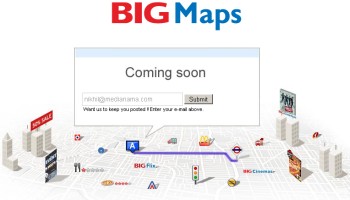
The website for Reliance’s BIG Maps is now live – here, though the product hasn’t been launched yet. I wonder if Google has stolen BIGMaps’ thunder with this launch. Latitude is a great product, and with the buzz that Google has generated with the launch, the early adopters should be on board soon.
BIG Maps has been in the pipeline for over a year and a half now, and based on what our sources have told us, location based services on the mobile and local business information are going to be a key ingredient of this rollout. We don’t have much to go by and BIG Maps has been in stealth mode for quite a while now. What we also know is that the ADA Groups investment vehicle Reliance Technology Ventures LTd (RTVL).
Whrrl, a service from Pelago is a mobile and web based service that “is at the intersection of social networking and local discovery”, which catalogs peoples activity, compiles history of the places they’ve visited, events they’ve attended on a map, allowing others to rate, review and comment. There’s also a micro-blogging feature, allowing them to update their location and/or status. Sounds similar to Google Latitude, doesn’t it? Take a look at Whrrl here.
We wouldn’t be surprised if the Whrrl concept is being integrated into BigMaps, but since Whrrl uses Google Maps, BIG should look at collecting their own map data, for which they can rely on Reliance Communications; we think this battle will be won by the company that has the most and the most accurate data.


This website uses IntenseDebate comments, but they are not currently loaded because either your browser doesn't support JavaScript, or they didn't load fast enough.
1 Comments until now.
Couple of quick notes:
1) Google Maps is still very much a stock international install as an app. It is not localized. Thus you see the gaping holes in the product like directions, traffic data etc. Stupid of them to do that, but I think this is still a tiny market in India. They should not take it easy, but they can afford to.
2) A common mistake that people do while looking at Google's products is to examine the parts individually than look at what the sum of those parts amount to. From that perspective it is a HUGE thing.
Google already mines data about where you are searching/accessing its services from what I am guessing is ISP level data, which is dug out from ASNs.
This is used for their recommendation services (emphasis mine): "Your recommendations list is automatically generated. It takes into account the feeds you're already subscribed to, as well as information from your Web History, including your location."
Google's core business is connecting the various dots about you to draw the best advertising profile picture of you. This is only another step in that process.
3) I have been using various mobile location apps now, incuding Wayfinder, Nokia Maps and Google Maps, the current GM release is by far the and average-Joe-friendly implementation I have seen of the product. It seamlessly ties in with their existing products
4) This is just a ramp-up of their crowd sourced approach to eventually doing complete maps. I still think they can pick up someone like a MapmyIndia for cheap, especially in this environment, but why should they, when you, me and our uncles will do it for them for free? :-)